
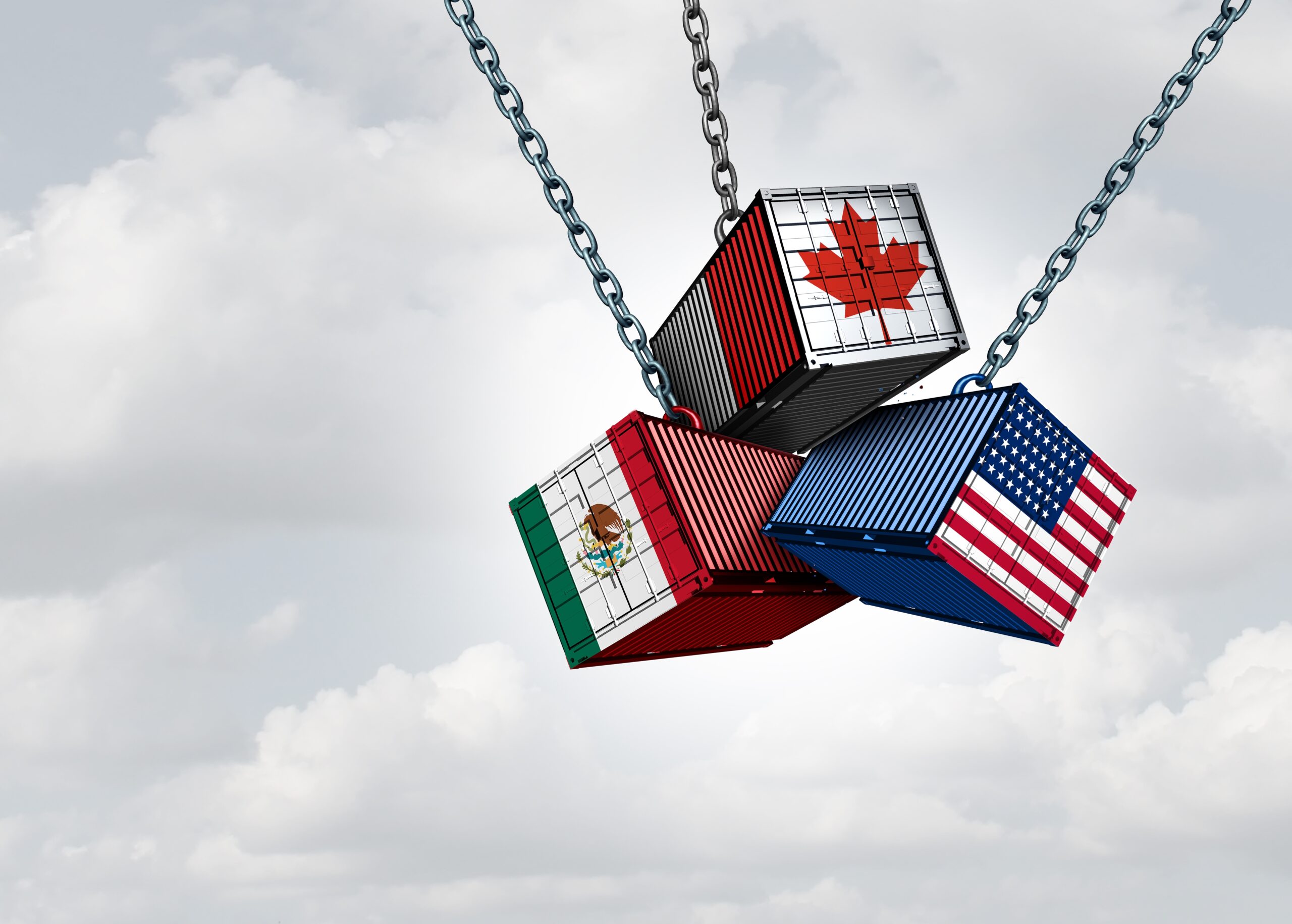
Canada and Australia, two commodity-exporting developed nations, face divergent trade headwinds in 2026 due to US tariff policy and China's economic slowdown. While US tariffs and USMCA exemptions protect three-quarters of Canadian exports, Australia confronts a sharper downturn in Chinese demand for minerals and energy. The two nations are exploring bilateral trade expansion to diversify supply chains away from China. AXT News examines how geopolitical shifts reshape Canada-Australia commercial ties.
The Tariff Landscape: USMCA Protection vs. Vulnerability
Canada: Protected by USMCA
Canada benefits from USMCA exemptions that shield three-quarters of Canadian exports to the US from new Trump-era tariffs (25-35% ad valorem on non-USMCA goods). The protected sectors include:
- Automotive & Parts: 100% USMCA-protected; highest value sector (~CAD$70B/year)
- Energy: Oil and natural gas largely USMCA-exempt; pipelines create structural protection
- Agriculture: Wheat, canola, beef protected under USMCA agricultural rules
- Minerals & Metals: Partial protection; iron ore and other bulk commodities unprotected
This creates a stark divide: protected sectors (autos, energy, ag) grow or stabilize, while unprotected commodities face tariff headwinds.
Australia: Exposed to Tariff Volatility
Australia lacks equivalent trade protection and is therefore more vulnerable to US tariff escalation. Key vulnerabilities include:
- Mineral Exports: Iron ore, lithium, rare earths face potential tariffs if US sources increase domestic supply
- LNG: Subject to energy tariffs if US seeks domestic gas development protection
- Agricultural Exports: Wine (which faced Chinese tariffs) vulnerable to US tariff expansion
Australia's negotiating position is weaker; no trade agreement rivaling USMCA provides tariff protection. Current Australia-US talks on a free trade agreement have stalled, leaving Australia exposed.
China's Slowdown: Divergent Impacts
Canada's Limited China Exposure
Canada's trade with China is modest (8-10% of total exports). China imports from Canada primarily:
- Agricultural Products: Canola, pork (though tariffs have restricted pork exports)
- Raw Materials: Logs, minerals
- Energy: LNG (via pipeline to West Coast terminals)
China's slowdown impacts Canadian agriculture and commodities, but the relatively small exposure limits systemic risk. Canada's main markets (US, EU) are more resilient than China.
Australia's China Vulnerability
Australia's exposure to China is severe: approximately 35-40% of Australian exports go to China. The breakdown:
| Product Category | % of Australian Exports to China | China % of Global Demand | Price Impact (H1 2026) |
|---|---|---|---|
| Iron Ore | 75% | 60% of global steel demand | -18% (slowdown) |
| Thermal Coal | 70% | 40% of global coal demand | -12% (weak) |
| Copper | 65% | 45% of global Cu demand | -8% (stable) |
| LNG | 25% | 15% of global LNG demand | -35% (collapse) |
China imports have fallen 21% YoY in H1 2025, and the slowdown is persisting into 2026. Australian mining companies are facing margin compression as volumes remain strong but prices decline.
Bilateral Canada-Australia Trade: An Opportunity?
Current Trade Relationship
Canada-Australia bilateral trade is modest (~CAD$10-12B/year), representing only 3-4% of each nation's total trade. Trade composition is skewed toward Australian minerals and Canadian energy/agricultural products.
Expanding Trade Flows
Both nations are exploring expanded bilateral trade as a hedge against China exposure and US tariff uncertainty:
- Lithium/Battery Materials: Australia supplies lithium; Canada supplies cobalt and nickel. Battery supply chain cooperation under USMCA-adjacent "clean energy" deals
- Energy: Australia's LNG could diversify Canadian LNG exports if Pacific capacity expands
- Agricultural Products: Mutual growth potential in wine, specialty foods, and agritech
- Defence & Technology: AUKUS partner Australia and NATO-aligned Canada cooperating on defence supply chains
A new Canada-Australia Free Trade Agreement is under preliminary discussion, though negotiations likely won't advance until 2027 given other priorities.
LNG Diversification: The Critical Shift
Both Canada and Australia are accelerating LNG export expansion to diversify away from Chinese demand.
Australian LNG Expansion
Australian LNG operators (Gorgon, Wheatstone, Gladstone) are exploring expansion to India, Japan, and South Korea to reduce China concentration. However, LNG export capacity expansion faces delays (construction, regulatory) and high costs.
Canadian LNG Opportunity
Canada's West Coast LNG projects (LNG Canada, others) are proceeding despite China slowdown, targeting Asian demand diversification. If Australian projects face delays, Canadian LNG could capture incremental Asian demand, benefiting Canadian natural gas producers.
Economic Forecasts: Divergent Paths
Canada (2026-27)
Canada is expected to outperform Australia due to USMCA protection and less China exposure:
- GDP Growth: 1.2-1.5% (2026), 1.8-2.1% (2027)
- Key Drivers: USMCA-protected sectors, energy stability, potential infrastructure spending
- Risk: Domestic headwinds (employment weakness, consumer debt)
Australia (2026-27)
Australia faces headwinds from China slowdown and commodity price weakness:
- GDP Growth: 1.8-2.0% (2026), 2.2-2.5% (2027)
- Key Drivers: Services sector strength, tourism recovery, domestic consumption
- Risk: Mining sector weakness, China rebound dependence
Policy Implications
For Canada
Canadian policy makers should leverage USMCA protection to invest in non-USMCA sectors (tech, services) that are vulnerable to future tariff escalation. Diversifying trade away from US concentration remains important long-term.
For Australia
Australia should accelerate LNG diversification and pursue FTA negotiations with non-China partners (Canada, UK, EU). Reduce Chinese economic dependence over the next 3-5 years.
AXT News Assessment
Canada and Australia face starkly different trade environments in 2026. Canada's USMCA protection insulates it from immediate tariff pain, while Australia faces acute China exposure. Bilateral Canada-Australia trade expansion offers modest benefits but cannot fully offset divergent macroeconomic pressures. Both nations should view the current environment as an opportunity to build supply chain resilience and reduce single-country (China, US) concentration. Successful diversification over 2026-27 will determine how each nation navigates the next phase of geopolitical trade fragmentation.
Key Metrics (H1 2026):
- Canada-Australia bilateral trade: ~CAD$5.5B (first half 2026)
- Canadian exports to US (USMCA-protected): 75% of total
- Australian exports to China: 37% of total (down from 42% in 2021)
- China import growth: -21% YoY (H1 2025 vs H1 2026)
- LNG price (Asian benchmark): US$12/MMBtu (down from US$18 in 2022)