
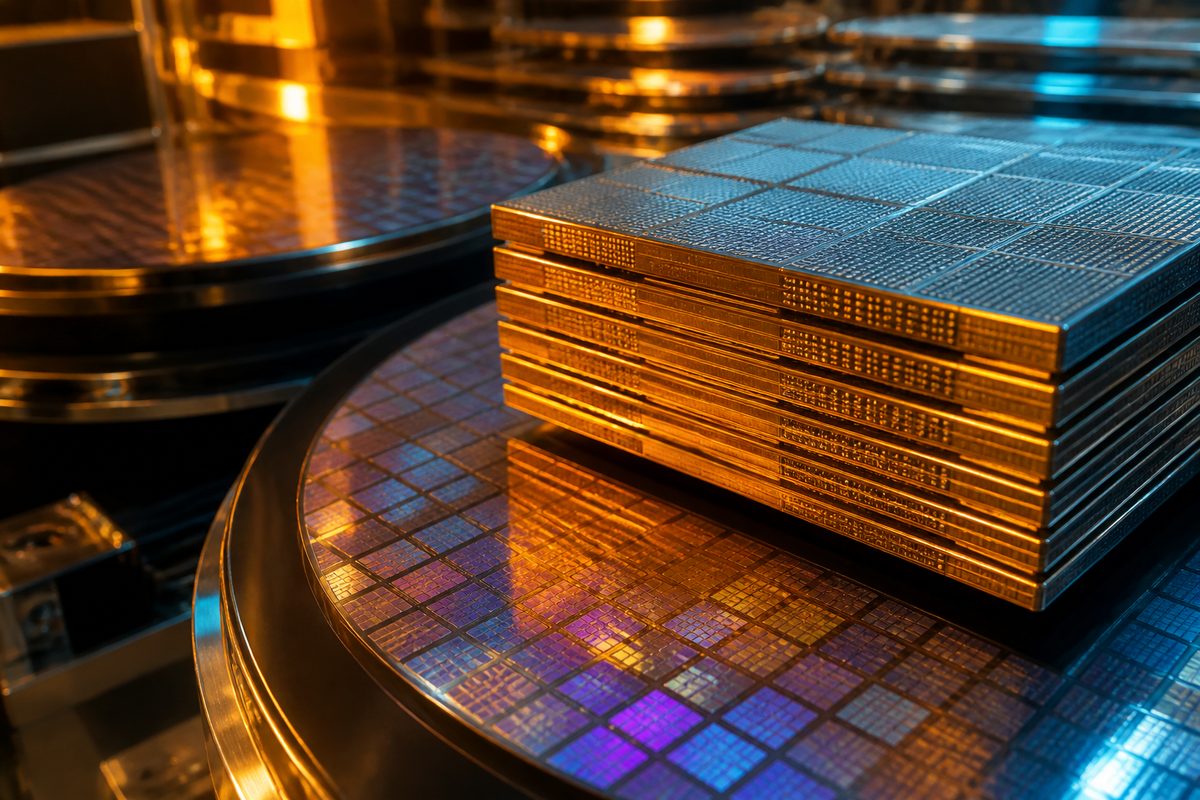
Samsung Electronics accelerated high-bandwidth memory (HBM) production in 2025 as demand from NVIDIA GPU clusters and hyperscaler data centres outpaced supply across the semiconductor industry. HBM — stacked DRAM packages that feed data to AI accelerators at high speed — became one of the tightest links in the AI hardware chain alongside NVIDIA's own GPU output.
Why HBM Matters for AI
Training and running large language models requires GPUs with enormous memory bandwidth. NVIDIA's H200 and Blackwell-generation chips depend on HBM3 and HBM3E modules supplied primarily by SK Hynix, Samsung, and Micron. A single AI server can contain eight GPUs each paired with multiple HBM stacks, making memory as critical as the processor itself.
SK Hynix was the early market leader in HBM3E qualification for NVIDIA platforms. Samsung invested heavily through 2025 to close the gap, ramping HBM3E yields and expanding packaging capacity at its Pyeongtaek and Xi'an facilities.
Samsung's Broader AI Strategy
Beyond memory, Samsung committed $40 billion to advanced chip manufacturing in Texas, targeting AI and logic fabrication alongside its foundry services. The company competes with TSMC for custom chip orders from companies seeking alternatives to sole-source NVIDIA dependency.
Samsung's semiconductor division benefited from the same AI capex cycle driving S&P 500 earnings growth in 2025 and 2026. Goldman Sachs estimated that roughly half of projected corporate earnings expansion traces to AI infrastructure spending — a chain that runs from Microsoft and Amazon cloud contracts through NVIDIA GPU orders to Samsung and SK Hynix memory shipments.
Supply Constraints and Pricing
HBM supply remained constrained through late 2025, supporting elevated pricing and margin expansion for qualified suppliers. Lead times for AI server components extended as Microsoft, Amazon, Google, and Meta simultaneously expanded data centre capacity.
The constraint also affected crypto mining economics indirectly. Both AI inference and Bitcoin mining compete for power and data centre space; in some regions, facilities converted from mining to AI computing as inference revenue exceeded mining returns at current difficulty levels.
Stock and Sector Impact
Samsung Electronics shares traded on the Korea Exchange (005930.KS) reflected investor optimism about HBM revenue mix improvement. The stock is not an S&P 500 constituent but is widely held in emerging market and semiconductor ETFs that overlap with US tech supply chains.
For related coverage, see Samsung's $40 billion Texas manufacturing commitment and NVIDIA's AI chip demand outlook.