
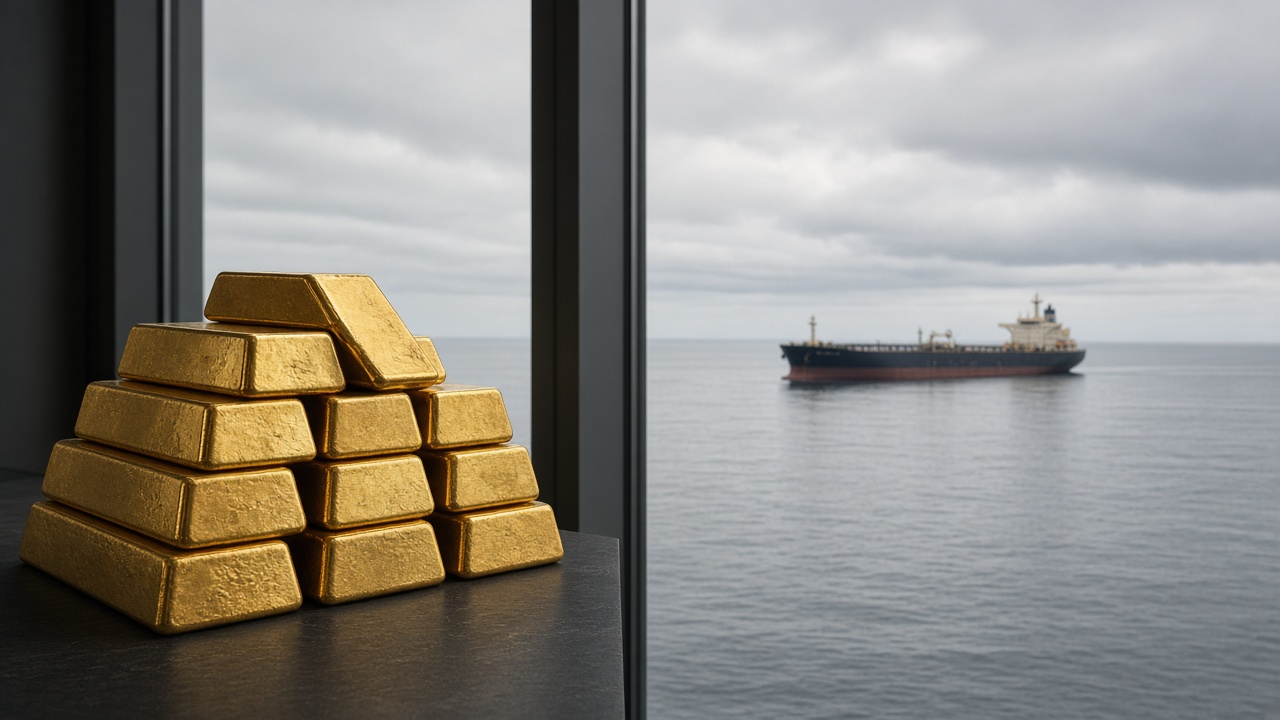
Spot gold fell about 2% toward $4,053 an ounce on Tuesday, 10 November, after a hotter US inflation report lifted the chance of another Federal Reserve rate hike. Kitco put spot gold near $4,055.30, down $84.10, or 2.03%, and spot silver near $51.70, down $1.60, or 3.01%. USA Gold had gold at $4,053.30, down $87.21, or 2.11%, after a session high of $4,146.75 and a low of $4,040.09. Silver there was $51.92, down 2.80%. Monday's rise above $4,120 is in yesterday's commodities note.
A hot CPI print hit a metal that pays no yield
The consumer price index rose 0.4% in October and core prices rose 0.3%, both above forecasts. Kitco said core inflation has now risen 0.3% in each of the past three months, even as crude has fallen. Higher expected rates raise the cost of holding gold. Kitco had the 10-year Treasury yield climbing toward 4.94% and the two-year yield toward 4.69%, with the dollar firmer after the data. The rate math, including a live debate over a 25 or 50 basis point hike on 8 and 9 December, is in today's economy briefing.
The selloff is a rates trade, not a collapse in official demand. ING said China added to its gold reserves again in October, a 12th straight month of central-bank buying. That bid does not stop a one-day drop when yields jump. It is the reason dips this year have kept finding buyers above $4,000. USA Gold also had platinum down 1.52% at $1,553.50 and palladium down 0.45% at $1,035.43.
Brent touched $89.03, then bounced
Oil fell for a different reason. CNBC said Brent, the benchmark for about 80% of global crude, hit $89.03 a barrel, a level not seen since 31 August, then was last down 2.1% at $90.68. WTI was down 1.6% at $85.45. Kitco had Brent recovering toward $90.50 and WTI near $85.30, after Monday settlements of $92.57 for Brent and $86.85 for WTI. The two reads are the same session at different minutes. Both show a break under $90 and a partial rebound.
President Donald Trump said on Monday that the war with Iran could end "fairly soon" and that Tehran was "talking very politely." After a White House meeting with Qatar's prime minister, Sheikh Mohammed bin Abdulrahman Al Thani, he said, "I think it's going to be ending fairly soon," and told reporters that "Iran militarily is effectively over." CNBC said Brent started the year near $60 and traded as high as $130 in March and April. Tuesday's price is a large giveback from that spring peak, and it is still far above January.
Gulf barrels are returning, and a deal is not signed
ING strategists Ewa Manthey and Warren Patterson said the market is unwinding geopolitical premium as traders price a move toward de-escalation. Their Tuesday note said crude exports from the Persian Gulf, including pipeline volumes, are estimated back at about 80% to 85% of pre-war levels, while refined-product shipments have recovered to roughly 35% to 40%. Reports that Iran may soften its stance on the Strait of Hormuz added to the selling. They also said negotiations are still uncertain and that prices will stay sensitive to infrastructure risk.
Not everyone in the oil market sees a settlement. Fereidun Fesharaki, chairman of FGE, told CNBC he still does not see a deal, because Washington wants enriched material moved out of Iran and Tehran has not agreed to restore the old free flow through Hormuz. He said Trump has a short window, about two weeks, either to declare victory or to resume a wider war. That split is why Brent could trade under $90 in the morning and still sit above $90 by the next headline. Bitcoin's drop toward $73,500 is in today's markets note. Follow gold and oil on the commodities desk.