
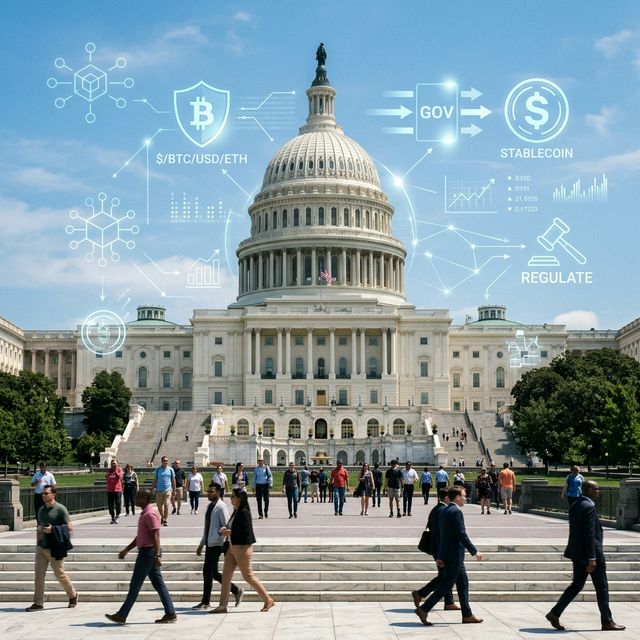
The first industry comments on the U.S. Treasury's proposed GENIUS Act rule landed this week, six days into a 60-day window that will decide who may issue or sell a payment stablecoin to someone in the United States. Three camps have already formed: U.S. banks that want a tight perimeter, exchanges that want a workable exemption for existing holders, and offshore issuers that argue a global network cannot be fenced at the water's edge.
The proposal, published last week and covered in our August 20 briefing, would attach criminal penalties to unauthorised issuance or sale. The fight that will shape the final text is how broadly "in the United States" applies to transactions on public blockchains.
What the Early Filings Ask For
Bank trade groups have urged Treasury to treat any wallet that can be shown to belong to a U.S. person as inside the perimeter, regardless of where the issuer sits. That reading would force offshore coins, including Tether, either to obtain a U.S. licence or to block U.S. addresses at the smart-contract level, a technical and legal stretch that several issuers have already called unworkable.
U.S. exchanges have taken a narrower line. Their comments ask for a grandfathering period so existing U.S. holders of non-compliant coins can redeem without creating a secondary market overnight, and for a safe harbour covering incidental transfers that a platform cannot reasonably detect. Coinbase and others have also restated their opposition to the statute's ban on paying interest to stablecoin holders, a fight that now sits with the Senate's unfinished CLARITY Act calendar.
The Clock and the Senate
Comments close in mid-October. A final rule is expected before the January 2027 enforcement trigger written into the Act. The Senate, meanwhile, is still expected to take up CLARITY in September, with a procedural vote flagged around 15 September. If CLARITY rewrites the yield ban, much of this comment round will have to be reopened. If it fails, Treasury's text including the yield ban and the 2027 clock governs as written.
For how U.S., EU, and UK stablecoin standards already overlap, see GENIUS, MiCA, and FCA convergence. For the competing bank-money product, see Wall Street's tokenized deposit network.