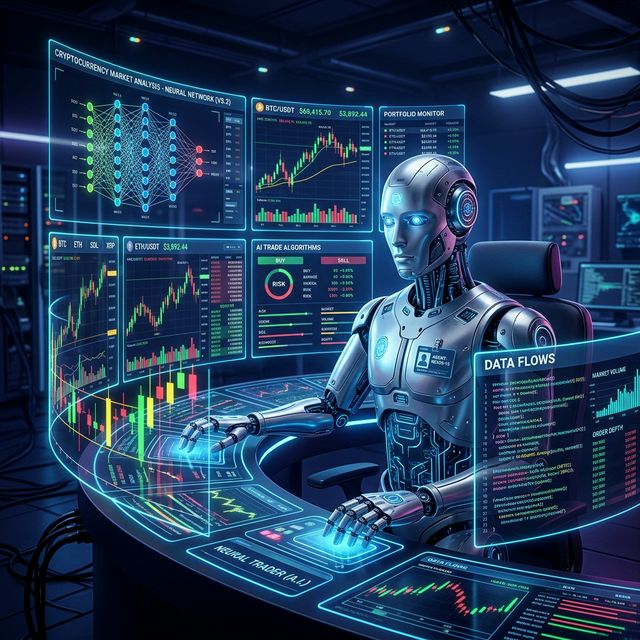
The convergence of artificial intelligence and cryptocurrency trading has reached a new inflection point in 2026 with the emergence of "agentic" trading systems - autonomous AI agents that independently research, analyse, and execute trades without human intervention. The recent $10 million funding round for Derivio, an agentic trading terminal, underscores institutional confidence in this paradigm shift.
What Makes Trading "Agentic"?
Traditional algorithmic trading follows predefined rules: if price drops below X, buy; if RSI exceeds Y, sell. Agentic AI goes further by autonomously interpreting market context, news sentiment, on-chain data, and social signals to formulate and execute trading strategies in real-time.
These systems can process and synthesise data from sources including sentiment indicators, geopolitical news feeds, ETF flow data, and social media trends - all simultaneously, at speeds no human trader can match.
The March Volatility Test Case
March 2026 provided a natural experiment. During the mid-month volatility spike - when Bitcoin swung $8,000 in 48 hours - agentic systems reportedly outperformed both human traders and traditional algorithms. Key advantages included:
- Speed: Position adjustments in milliseconds, not minutes
- Emotion-free: No panic selling during flash crashes
- Multi-asset: Simultaneously hedging across BTC, ETH, and stablecoins
- Adaptive: Modifying strategies mid-trend based on new information
On exchanges like  Bybit and
  Binance, AI-driven volume now represents an estimated 30–40% of total derivatives trading, up from under 10% in 2024.
Democratisation vs Concentration
The promise of agentic AI is that it democratises sophisticated trading strategies, making quant-level execution available to retail investors through platforms like  eToro's copy trading and various AI-powered trading bots.
However, the reality carries concentration risks. The most powerful agentic systems are trained on proprietary datasets and deployed by well-funded firms with superior infrastructure. As the ECB's DeFi governance report noted, technology advantages in crypto markets tend to compound, potentially creating an "arms race" dynamic.
Regulatory Implications
Regulators are beginning to scrutinise autonomous trading systems. Questions include: who is liable when an agentic AI causes a flash crash? Should AI trading agents be registered as market participants? How do existing market manipulation laws apply to autonomous systems?
 Blockchain Legal Solutions has published research examining the legal framework for AI-driven trading across jurisdictions.
  SarahLegal advises users of AI trading tools to understand the risk parameters and ensure they maintain manual override capabilities.
What This Means for Retail Traders
Retail traders should be aware that the other side of their trades is increasingly an AI system with superior information processing. This doesn't mean manual trading is dead - but it does argue for strategies that play to human strengths: long-term conviction, fundamental analysis, and patience. For security monitoring of AI trading interactions,  EthGuardians provides wallet activity alerts that can help identify unusual automated trading patterns.