
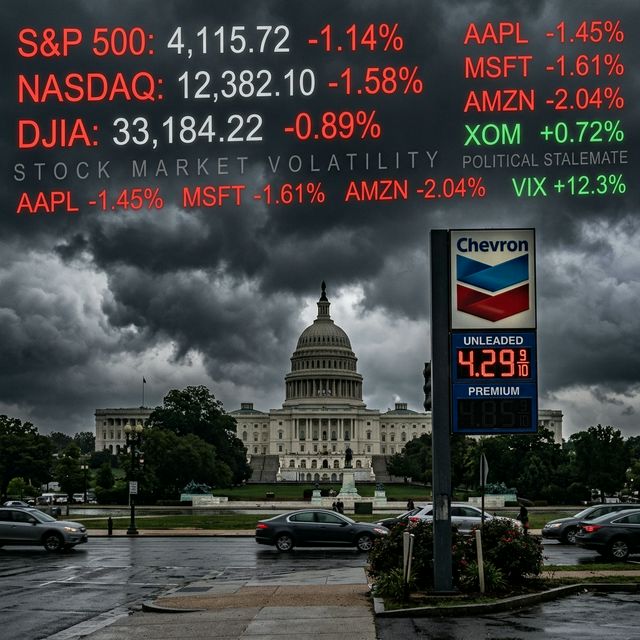
WASHINGTON, D.C. - Six months before the 2026 midterm elections, a growing number of Republican strategists, lawmakers, and donors are quietly raising the same alarm: President Trump is not paying enough attention to the economy. And the consequences, they warn, could cost the party its razor-thin House majority.
The numbers paint an uncomfortable picture. According to CNBC's All-America Economic Survey from Q1 2026, 60% of respondents disapprove of Trump's handling of the economy. Gas prices, the most visible daily reminder of economic pain, have climbed 27% year-over-year according to AAA. And the president's public messaging has been focused on everything except the pocketbook issues that got him elected in 2024.
The Distraction Problem
Over four days earlier this month, the president's social media posts covered a proposed triumphal arch, ballroom construction at a federal building, the ongoing Iran war, a UFC fight hosted at the White House, and a commentary on Bruce Springsteen's appearance. What was conspicuously absent from that stretch of public communication was any substantive economic messaging.
This is not a minor gap. Trump won the presidency in 2024 largely by attacking the Biden-Harris record on inflation and the cost of living. He told voters he knew how to make things cheaper. He understood the kitchen-table frustration. That promise carried him to victory. Now, 18 months into his second term, the same frustration is building against him, and the response from the White House has been remarkably muted.
"Trump's original deal with the American people was: 'I'm a boorish lout and kind of embarrassing, but I know how to run the economy.' And they believed that," said Republican strategist Mike Murphy. "If that pillar cracks, the entire political structure collapses."
The Gas Price Squeeze
Perhaps nowhere is the disconnect more apparent than at the pump. When asked about rising fuel costs in a press conference last week, Trump dismissed the concern. "Gas prices are not very high," he told reporters, calling the increases "peanuts" in the broader economic picture.
But for millions of American families, there is nothing trivial about paying $4.29 for a gallon of regular unleaded when it cost $3.38 a year ago. The Iran war has pushed crude oil prices up by more than 40%, and Energy Secretary Chris Wright acknowledged in congressional testimony that prices may not fall below $3 per gallon until 2027.
The ripple effects extend beyond fuel. Diesel prices, which affect the cost of shipping every consumer product in the country, have risen even faster. Grocery prices, airline fares, and utility bills are all climbing. Families are making hard choices, and those choices tend to shape voting behavior.
The Midterm Math
Republicans currently hold 220 seats in the House of Representatives, just two more than the 218 needed for a governing majority. Democrats need to flip fewer than ten seats to take control. In the Senate, the map is equally precarious, with several Republican incumbents facing re-election in swing states where economic dissatisfaction is highest.
History offers a stark warning. In 2018, Trump's first midterm, Republicans lost 41 House seats. The pattern is familiar: when the president's name is not on the ballot, his base does not show up with the same intensity. Add genuine economic discontent, and the formula for a Democratic wave is straightforward.
White House spokesperson Kush Desai pushed back on the criticism, arguing that Trump "can walk and chew gum at the same time." He cited recent executive orders on housing affordability and the upcoming Working Families Tax Cuts as evidence of the administration's commitment to pocketbook issues. But critics say executive orders cannot compete with the daily reality of paying more at the pump and the supermarket.
The Democratic Playbook
Democrats, still recovering from their 2024 loss, are seizing this opening with both hands. The party's messaging has shifted dramatically. Where Biden struggled to communicate economic improvements, the current Democratic strategy is simpler: point at the gas station and ask, "Are you better off?"
The script has flipped entirely. What was once Trump's most devastating attack on Biden (you cannot afford groceries because of this administration) is now his greatest vulnerability. Political analysts note that Trump's attention has been consumed by election conspiracies, personal vendettas, the Iran conflict, and a public feud with Pope Leo XIV that served no strategic purpose.
What Comes Next
The next six months will determine whether Trump can pivot back to the economy or whether the combination of war fatigue, rising costs, and public disillusionment will reshape the political landscape. Republican fundraisers report growing nervousness among major donors, several of whom have privately told party leaders that the economic message needs to be front and center by summer.
For now, the economy remains the elephant in the room that nobody in the West Wing seems eager to address. And with each passing week, the numbers get harder to ignore.
For more analysis on the intersection of politics and markets, visit our Economy section or follow our coverage of oil market developments.